Siam Celadon

209

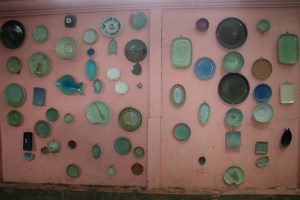
At our favourite Thai restaurant in New Zealand our delicious food was always served on beautiful light green dishes. When I asked the staff where I could buy similar china they just smiled. I guessed they had brought it with them from Thailand. So you can imagine my delight when we found the Siam Celadon shop in Chiang Mai. It is in a beautiful 19th century house, which is built around this attractive courtyard. The shop at the front is filled with green and blue pottery made using ancient Chinese techniques, which involve a transparent glaze that sometimes leaves the pieces covered in tiny cracks. At the back is the Raming teahouse, where we had lunch served on Siam Celadon china, and a lovely walled garden decorated with seconds (see pics below). For a china collector like me it was the perfect way to spend the day.

210206


Chiang Mai

056

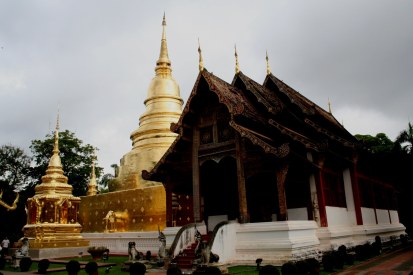
I’m not sure how many temples there are in Chiang Mai but it seems like there’s one on every street corner! And each one seems more splendid than the last. The temple in this photo is Wat Phra Singh, which we visited first because it was closest to our hotel. Our guidebook says it houses the most revered Buddha image in Chiang Mai and that it is an excellent example of Lanna architecture. It is certainly very impressive with its bright gold stupa and immaculate, peaceful gardens. We visited many temples on our walk around the old city and it was awe inspiring. The displays in the Lanna Folklife Museum expertly explain the religious beliefs and customs of the northern Thai people. After our visit there, we were better informed about what we were looking at in the temples. The people watching was good too: robed monks mingled with locals bringing their offerings and saying their prayers as well as tourists from all over the world. It is all very relaxed and inclusive.

Forest retreat

059

During a weekend spent in KL we explored the tracks through the Forest Research Institute of Malaysia or FRIM as it’s known by locals. It was established in 1925 and by the 1950s had developed into a large plantation with research facilities in the areas of chemistry, silviculture, botany and zoology. It also provides the people of KL with a large green space for recreation. We really enjoyed walking the tracks in the shade of tall trees, listening to the abundant birdsong and even catching glimpses of monkeys through the foliage. We also walked up the path beside some small waterfalls where children were paddling and a bride was having her photo taken. It puzzled us that most people were walking along the roads and not taking advantage of the quieter, shadier tracks. But that meant we had them more-or-less to ourselves, which was a real treat in a city with a population of 7 million.

Faded splendour

037

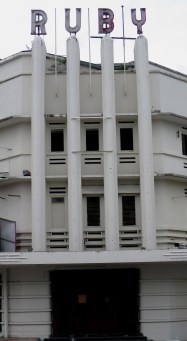
Unlike Penang or Malacca, Ipoh’s old town is somewhat rundown and unattractive. There are pockets of restored and re-purposed buildings, which is encouraging, but many of the architecturally interesting buildings are almost derelict. I came across a beautiful book (in the lovely Gerak Budaya bookshop in Penang!) about the Danish architect B.M. Iversen, who lived in Ipoh in the 1930s. He designed many buildings here, including several cinemas, one of which was the Ruby. We found it and took this photo. It is an attractive art deco building taking up a prominent corner and you can still appreciate its lovely lines. It now houses a downmarket furniture store and the unsympathetic signage and displays of low-cost furniture detract from the Ruby’s charm. B.M. Iversen’s daughter Ruth Iversen Rollitt, who wrote Iversen: Architect of Ipoh and Modern Malaya (Areca Books, 2015), was born and brought up in Ipoh. Recently she said:
“When I go back to Ipoh now, I weep. They don’t maintain it, it’s dirty, it was so beautiful previously … Ipoh is like the old George Town before it was revived. Because of the weather, it’s very difficult to maintain the buildings but the buildings in Ipoh are left to crumble. My father built many cinemas in Ipoh, they were burnt and most of them have been turned into furniture depositories. Ipoh is sad.”

Mountain ground squirrel

170

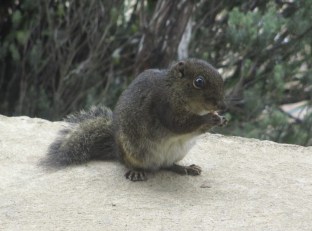
When you stop at the pondoks (shelters) to rest on the way up to Mount Kinabalu you see heaps of these squirrels scavenging nearby. They know that there’s food to be had and are quite tame. We had one pondok to ourselves on our way down and the little guy in the photo took the nut right out of my hand and then sat down next to us to enjoy it. We were soon joined by an enthusiastic climber on his way up – he asked us to take a photo while he held up a bright pink banner with his girlfriend’s name on it. She hadn’t been able to join him on the trip and this was his way of keeping her up to date with his progress. Then we were joined by a couple from the Netherlands, who sat down to eat their packed lunch. We met people from all over the world in our two days at Mount Kinabalu – many Malaysians from KL and other parts of west Malaysia, Singaporeans, Swiss, Japanese, Koreans, Australians. It all added to the wonderful experience.

How do they do it?

166

We could never have made it to the summit of Mount Kinabalu without the substantial aid of our friendly porter/guide. He carried over 10 kgs of our luggage on his back, while we had another 12 kgs between us in two day packs (mine being by far the lighter of the two!) He also guided us over the treacherous terrain and was constantly checking that we were managing. He had a walkie-talkie and kept in close contact with the others in our group as well as the authorities at the gate. When we stopped for a breather, usually taking the chance to have a long drink and something to eat, he simply crouched down and enjoyed a cigarette! As we were carefully negotiating the rocky steps, we would have to step aside for another porter carrying something incredibly heavy up to the base camp, which reminded us that almost everything up there has to be carted up on someone’s back! The porter in this photo is carrying a gas cylinder. They seem so sure-footed in their cheap plastic shoes and they run back down having deposited their loads at the top. They are extraordinary people.

Top of the world

148

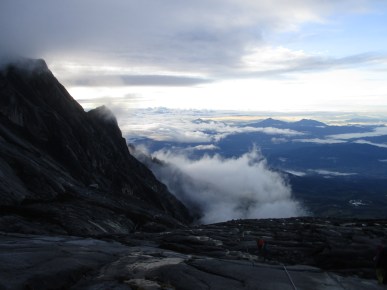
You feel as if you are at the top of the world when you’re standing at 4072 m near the summit of Mount Kinabalu in Sabah. We had this marvellous experience last Saturday. It was worth the gruelling climb up over hundreds of uneven steps and huge boulders. We left the base camp of Laban Rata at about 2.30am and made our way in the dark (with the help of headlamps and indispensable, experienced guides) up the steep incline to the top. We didn’t have the glorious sunrise that you see in many photos but the lightening sky streaked with clouds and the grey broodiness of the peaks at the top were spectacular. One has to hold on to those feelings when one is slogging all the way down. I think going down was infinitely more difficult!

Ipoh sunrise

010

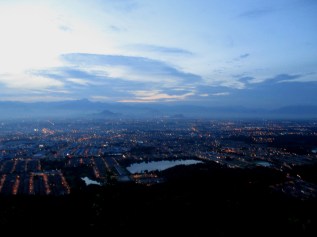
We watched the sun rise over Ipoh from half-way up Kledang hill. Having tramped up hundreds of steps to get there and sweating profusely despite the early hour, it was relaxing to sit still and enjoy the view – the lights of the city, the blue hills of the Cameron Highlands in the distance and the streaky clouds getting brighter with the rising sun. Once the sun was up, we walked further up the hill into the jungle, which to me always feels like a reward after the rigours of getting there. By the time we got down to the bottom, the temperature was already in the early 30s and all we could think of was a cool shower.

Preserving the past

136

Chinese seafarers were aware of Penang as early as the 15th century. Settlers from Sumatra arrived in Penang in the 18th century and in 1771 the sultan of Kedah signed an agreement with the British East India Company. Penang was also the capital of the Straits Settlements (which included Malacca and Singapore) for a while. One can almost feel the layers of history when one wanders through the narrow, winding streets of George Town and in 2008 it was declared a Unesco World Heritage Site. We visited Penang again a couple of weeks ago and had a delicious dinner in the Kebaya restaurant, which is part of the Seven Terraces Hotel – a row of seven restored 19th century Anglo-Chinese terraced houses (go to http://www.seventerraces.com/web/aboutus.htm to find out more). Investment banker Chris Ong, who grew up in Penang, and his business partner have done a wonderful thing here – he is passionate about his Baba heritage and the hotel and restaurant showcase his personal collection of Straits Chinese porcelain (for an interview with Chris Ong go to http://www.themalaymailonline.com/travel/article/10-things-about-chris-ong-hotelier-who-champions-penangs-heritage-shophouse).

Tin miner’s rice bowl

IMG_3415

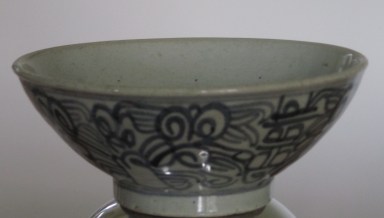
I was browsing in an antique shop in Penang and saw a stack of these bowls. The pleasant and informative shop assistant told me they were given to individual tin miners for their rice ration. Each had a different pattern and many of them were etched with the name of the owner on the inside. The Kinta Valley in Perak (the state in which we live) was the centre of the Malayan tin mining industry from the end of the 19th century.‘Perak’ means ‘silver’ so it is possible that the area was named after the silvery colour of the tin. I bought this particular bowl because I liked the decoration, it has a faint mark on the inside signifying whose bowl it was and we live close to the area where the tin miner who used the bowl may have worked. It is a lovely object. Today’s workers in Perak eat their lunches out of polystyrene containers, which you then see lying in piles of litter wherever you go. That doesn’t seem like progress to me!