Cable Bay

On a recent visit to the top of the South Island, we went to Cable Bay for the first time. Though it was the middle of a New Zealand winter, which is often grey and rainy, we were there on a gloriously clear day, as you can see in the photograph. As we edged our way along the narrow road to the bay, we came across a couple persuading a pair of cows into a paddock – apparently the cows were in disgrace because ‘they’d already munched their way through Grandma’s garden’. When we got to the bay and parked on the shingle, we noticed two more people bundled up against the cold wind, sitting on canvas chairs holding fishing rods. Then we put on our jackets, scarves and beanies and braved the elements ourselves, walking up the steep incline to read the information board. The bay was the site of New Zealand’s first overseas cable link – via Australia – and was opened in February 1876. It revolutionised the lives of settlers who could now get a message to their families in Europe in four days, instead of the six weeks it took a letter. The cable station operated till 1917, after which it was moved to the North Island, at Titahi Bay near Wellington. I’ve just checked the track details on the DOC website and noticed an alert – the track is closed for lambing. How much more Kiwi could it be? Cows, fishing, lambs and splendid isolation!

Too good to be true

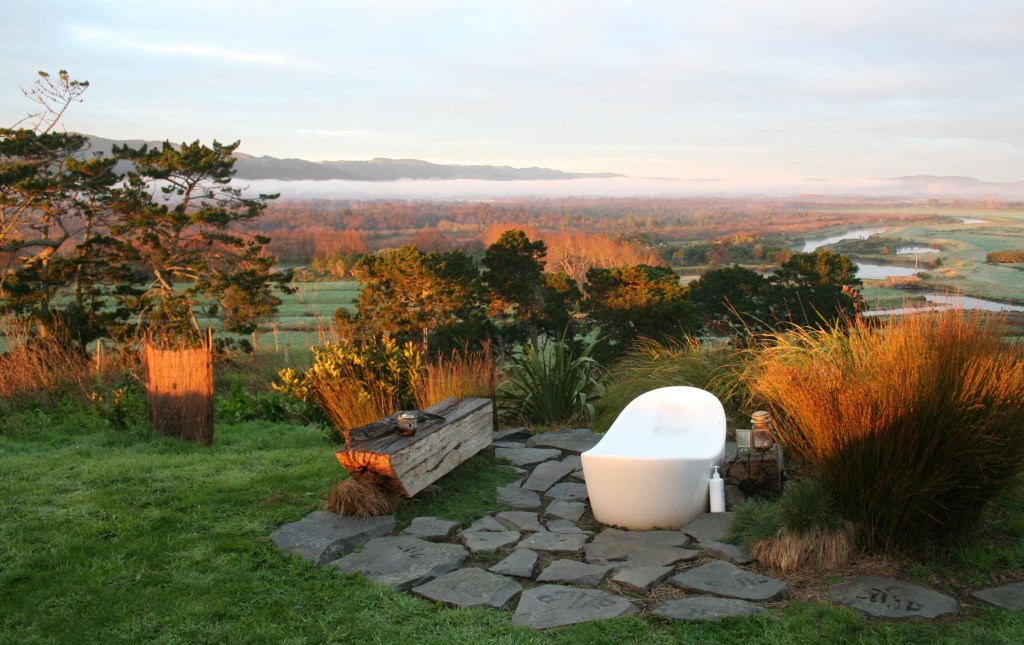
There is an old saying that if something seems to be too good to be true, it probably is. We recently spent a night in an off-the-grid eco-cottage where there was an outdoor bath. The cottage, which has both gas and solar panels but no electricity supply, has hot water and a hose to run it into the bath. However, we were there in July, which in New Zealand means it’s cold and wet. Getting up to cottage involved driving along muddy farm tracks and up a steep incline, which requires a four-wheel drive vehicle. Once we were in the cottage and had the fire going, there was no way I was going to take a bath in the open air! Fortunately there was a perfectly good indoor shower with a plentiful supply of hot water. It was a lovely experience having our dinner in front of the fire before getting into a comfortable warm bed. Then waking up to the sunrise turning the valley golden – as you see in the photo above. Perhaps we should go back in the summer when the prospect of an outdoor bath while drinking in the glorious view is much more enticing.

Freewheelin’

Bicycles for hire – Penang, Malaysia

We took up cycling during lock-down thanks to the gift of second-hand mountain bicycles by a friend. It was liberating to ride around mostly traffic-free country roads during those restricted weeks and it reminded me of the feeling of freedom a bicycle can bestow. It’s also true that you never forget how to ride a bike – I hadn’t ridden one for at least 40 years but had no problem at all, except for getting the hang of all those gears! We went for a ride this morning after a long break. And it seemed to me that the slogging up hills and the freewheeling down the other side was a metaphor for the ups and downs I’ve experienced recently. New Zealand has all but rid itself of the coronavirus and we’re at level 1, which is normal life but with closed borders. This has been cause for great satisfaction among the five million of us who live on these beautiful islands in the south Pacific. We’ve gone back to work and re-connected with family and friends – so good it feels like freewheeling down the hills on my bicycle, wind whistling past and sun on my face. But I’ve also experienced loss alongside family and friends – Jackie who lost Trevor, Simone and Ollie who lost Rachel, Rosanna who lost Chris and Jo who lost Jonathan. These sad losses have irrevocably changed lives and seem unbearable for those left behind. Lying awake in the long watches of the night thinking about them feels like slogging up an endless hill in the rain. It is almost always the first thing I think about when I wake in the early morning, wishing that sympathy could change anything for any of them.

Autumn calves

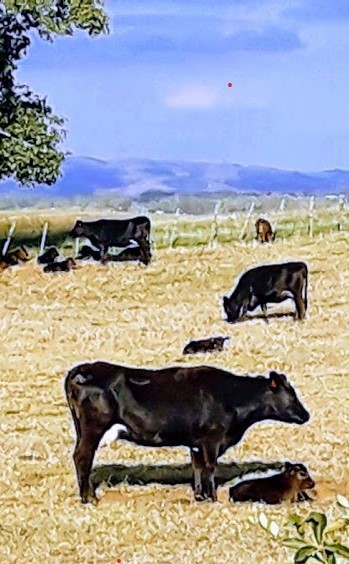
We are lucky to live on a farm, which gives us the lovely, wide views that have been a life-saver during lock-down. It also means we can walk out the gate and up the road without seeing anyone else. We do, however, see lots of animals on our meandering around the neighbourhood – cows, chickens, sheep, goats, hawks and the odd bold rabbit. It was a delight to find a paddock filled with cows and their new calves one sunny afternoon. There is something so hopeful about seeing young animals in the autumn.

As much sense as a chook

We live on a farm where there are plenty of free-range chickens, some of which wander into our garden. This is fine with us, especially if they lay us some eggs, which they do from time to time, and stay out of the vege garden. Today one of the hens was out on the road with her four little bundles of fluff. They were feasting off insects, oblivious to the danger from cars and trucks. It seems like a metaphor for those of us who rushed into the supermarkets as soon as the lock-down was announced and bought enough groceries in one day to feed 10 million New Zealanders, oblivious of the official announcements that the supermarkets will remain open and the food supply will be maintained. We need to be smarter than that! We have at least four weeks of lock-down ahead so we’ll need to pace ourselves and use our common sense. I’m happy to report that the hen and her chicks survived (by wandering back into the paddock beside our house) and so will we. Stay home and stay safe

Going green

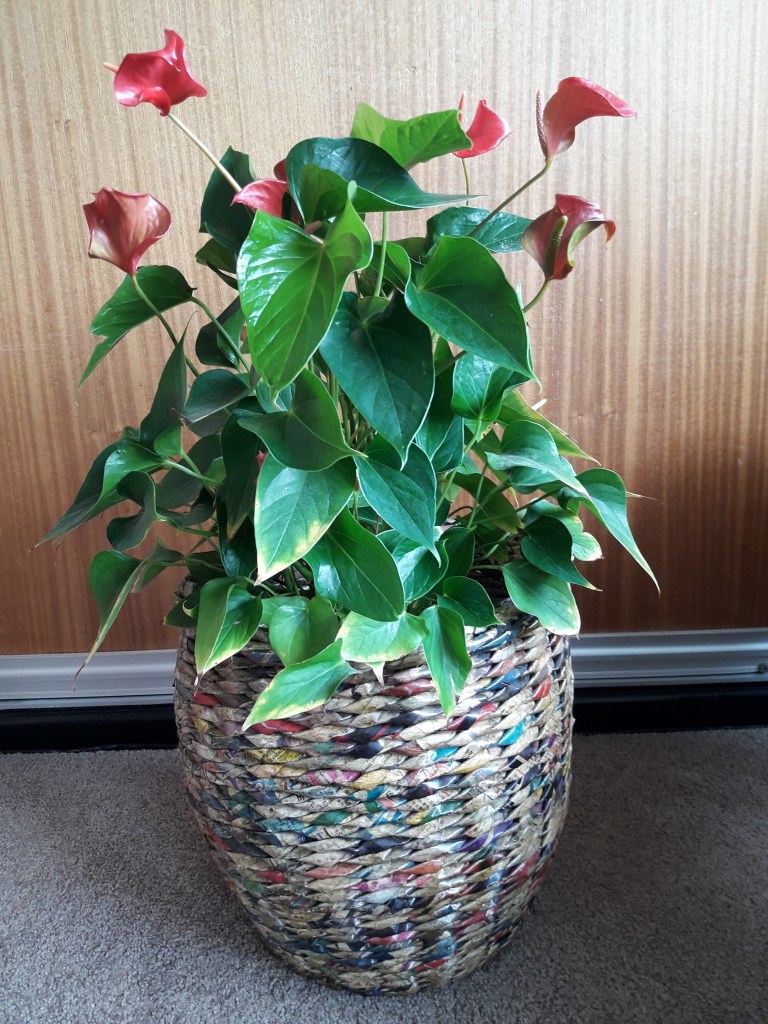
For months we’ve relied on our indoor plants for greenery. It hasn’t rained properly for weeks and outside plants, trees and fields are dry and brown. But yesterday and today it has rained off and on continually and one can almost watch the paddocks going green. How welcome this is when one is isolated – all New Zealanders are now working from home unless they are in an essential business. All our indoor plants have new green shoots, which seems like a welcome act of optimism, and helps counter the grey skies and feelings of impending doom. Stay safe everyone and be kind to yourselves and others.

A glimmer of hope

Oi_Raglan_1

Readers of this blog know well that Raglan is our favourite weekend getaway. We were there again last weekend and I walked through the Bryant Scenic reserve, as I’ve done often before. This time there was this notice, put up by Karioi Project https://www.karioiproject.co.nz/ – a community conservation group that is working to restore biodiversity in the coastal region around Karioi, the volcanic mountain that looms over Raglan and gives the beaches their distinctive black sand. By trapping and eliminating predators like stoats, rats and ferrets and setting up burrows, the Project has helped 22 oi chicks fledge from the Karioi coast, eight in the 2019 season. Oi are native grey-faced petrels, whose burrowing habit makes them susceptible to introduced mammalian predators. So reading this notice in this beautiful place on a sunny summer morning made my heart lift. Good things do happen, even though it may seem as if they’re very few and far between!

Strawberries

Strawberries

There is a strawberry and blueberry farm close to where we live. During the short summer season we go down there every couple of days to buy some of their delicious fruit. We try to get our fill before the season ends and never tire of a breakfast bowl of red and blue fruit or a pink smoothie. I was at the farm gate this morning and noticed a blackboard sign beside the racks of fruit. It informed customers that the farm would not be taking advance orders over the holidays as they have done in past years. The reason for this was the abuse suffered by the farm staff from customers who were not able to place large Christmas orders due to the shortage of fruit. My pleasure at picking up my punnets of fruit was soured by this news. During the season of joy and goodwill to all, there are some who spoil it for everyone by ranting at hard-working berry pickers! Shame on them! Fred Rogers, who is played by Tom Hanks in a new movie called A Beautiful Day in the Neighbourhood, said “There are three ways to ultimate success: The first way is to be kind. The second way is to be kind. The third way is to be kind.” I hope 2020 will be a kinder year for all of us.

Alexandra redoubt

008

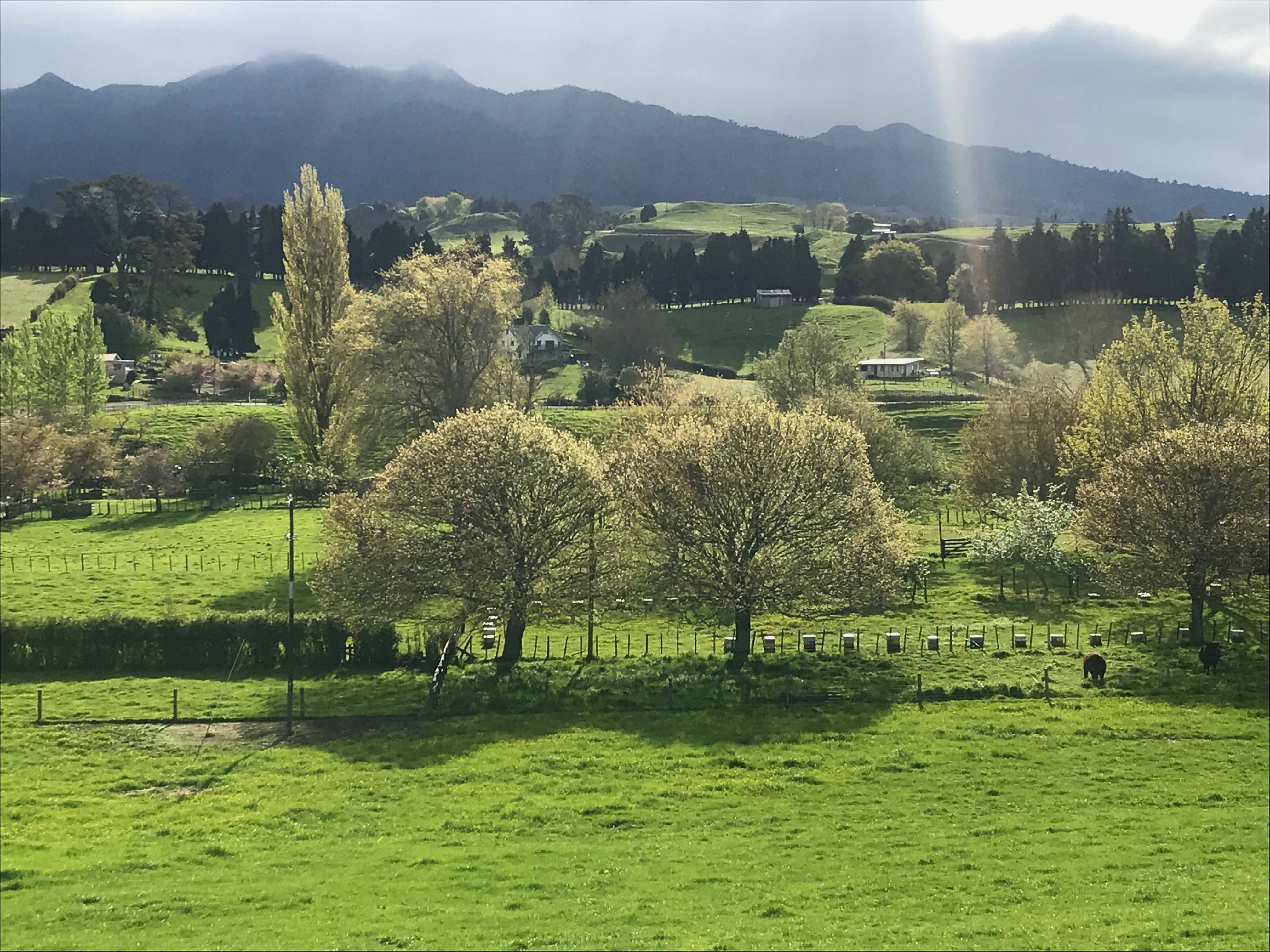
Yesterday it felt like summer may be on its way, helped by daylight saving which began on 29 September. The late afternoon was warm and windless so we took ourselves to Pirongia. A little way out of the small town is the Alexandra redoubt, which was built by the British colonial forces after Māori had been forced back behind the confiscation line. Tawhiao and his people settled in Whatiwhatihoe, just two kilometres beyond the aukati, Māori for the line that should not be crossed. Settlers in Pirongia (then called Alexandra) were afraid their small settlement was vulnerable to attack and so the redoubt was built. Pirongia was never attacked and the relationship between Māori  and Pākehā was remarkably good considering that more than a million acres of highly productive land had been confiscated. We stood on the grassy slope of the redoubt and gazed at the bucolic scene in the photo above. It was so peaceful bathed in the glow of the evening sun that is was hard to imagine the violent events of the 1860s and the extensive loss and deprivation that ensued for so many. It is also worth reflecting that keeping the redoubt maintained so that the public can visit it and read the history on the boards at the entrance is a good way of keeping alive this story and its meaning for us.

The east coast

Mount MaunganuiReaders of this blog will know that our favourite New Zealand seaside spot is Raglan, which is on the west coast of the North Island, south-west of the Waikato city of Hamilton. But last weekend we ventured over to the east coast to Mount Maunganui, known locally as the Mount. The two coasts couldn’t be more different. Raglan has waves courtesy of the Tasman Sea breaking off a series of points, black volcanic sand and a steep ridge line descending to the beach. Access to the beaches at the Mount is through gently undulating dunes and you emerge onto a wide white sand shore. There are some surf spots but generally the waves are small and placid as befits the Pacific Ocean. Raglan has kept its small surfer town feel whereas the Mount is all large modern houses, shopping centres and restaurants. Nevertheless we had a good day – Jim got into what surf there was and I took a long walk down the beach towards the mount itself and then followed the track that goes right round it. We got some tasty lunch from the food trucks that line the main beach before heading back across the Kaimai Range, which separates the Bay of Plenty from the Waikato.